

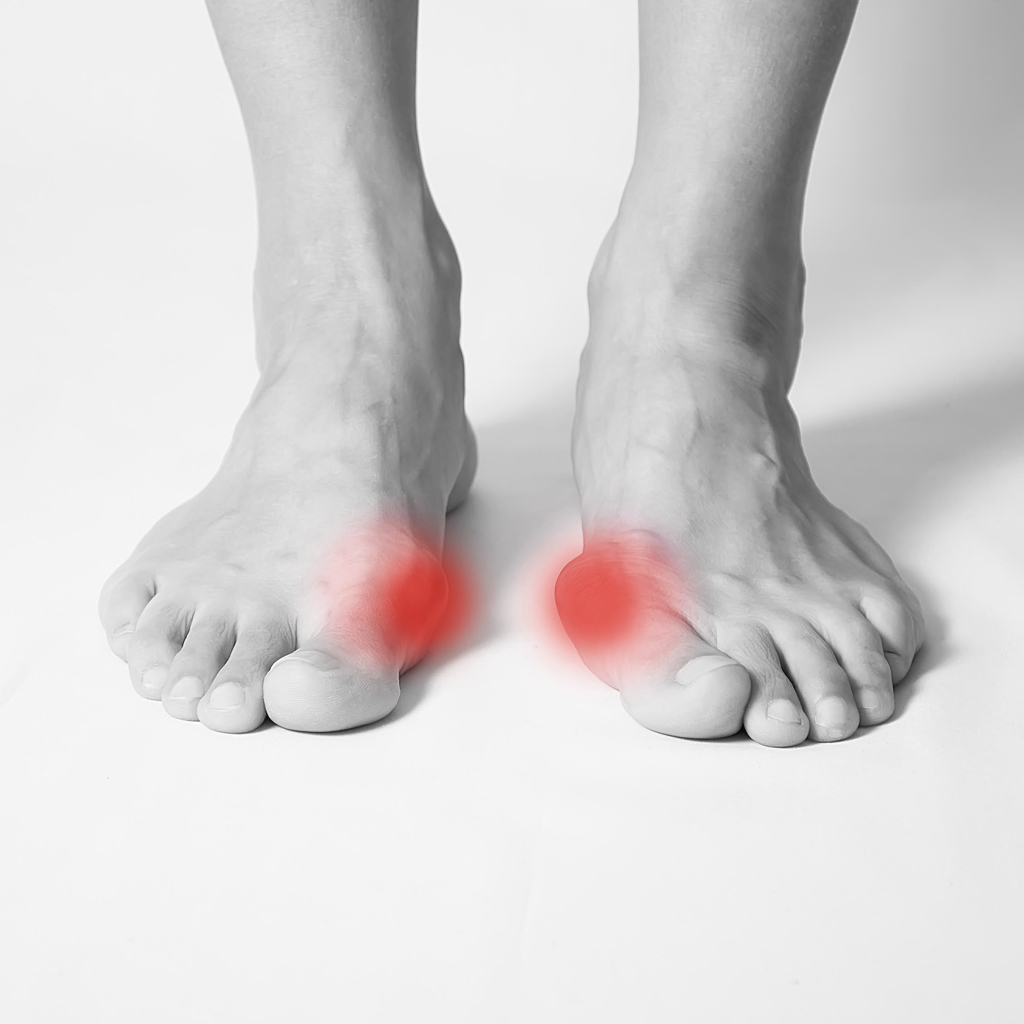
Hallux Valgus (Bunion)
Hallux valgus, commonly known as a bunion, is a deformity of the big toe in which the toe deviates towards the other toes, forming a characteristic bony prominence at its base. This condition may cause pain, inflammation, and difficulty walking if not managed promptly and appropriately.
Causes and Risk Factors
Hallux valgus may be hereditary or caused by external factors.
1. Genetic predisposition
– If there is a family history, the risk of developing the condition increases.
– It is associated with ligament laxity and weakness of the foot muscles.
2. Inappropriate footwear
– Tight shoes or high heels push the big toe towards the smaller toes and shift the centre of gravity onto the forefoot.
– Shoes with a narrow toe box increase pressure at the base of the big toe.
3. Pathological conditions
– Flat feet: Lack of proper arch support may place additional stress on the joint.
– Rheumatoid arthritis and other inflammatory arthritides may cause joint deformity.
– Neurological conditions that affect muscular balance in the foot.
4. Gait pattern and overloading
– Incorrect weight distribution on the sole, with increased pressure on specific areas.
– Repetitive strain (e.g. in athletes, dancers) may worsen the condition.
Symptoms
– A bony prominence at the base of the big toe, which may become swollen and painful.
– Pain and redness in the joint, especially after prolonged standing or wearing tight footwear.
– Stiffness and restricted movement of the big toe.
– Development of calluses or corns due to friction and pressure.
– Secondary deformities of the other toes (e.g. hammer toes).
Diagnosis
Diagnosis is made through:
– Clinical examination to assess the deformity and the mobility of the joint.
– Foot X-ray, to evaluate the angle of the deformity and the possible presence of arthritic changes.
Management and Treatment
1. Conservative methods
– Footwear modification:
– Choosing wide shoes made of soft material that do not compress the big toe.
– Avoiding narrow or high-heeled shoes.
– Orthotic aids:
– Toe separators or silicone pads to prevent friction and reduce pain.
– Orthotic insoles, especially in individuals with flat feet or poor weight distribution.
– Physiotherapy and exercises:
– Stretching and strengthening of the foot muscles to support the joint.
– Balance training for proper distribution of pressure across the foot.
– Avoidance of prolonged standing or intense activities that place strain on the bunion.
– Anti-inflammatory medication (e.g. ibuprofen) to reduce inflammation and provide temporary pain relief.
– Night splints: Used to help maintain the correct position of the big toe during sleep.
2. Minimally invasive treatments (if the bunion causes significant pain)
– Cortisone injections: Used to reduce inflammation, but they do not correct the deformity.
– Laser therapy and Shockwave Therapy: Methods that help reduce inflammation and stiffness.
3. Surgical Treatment (In Severe Cases)
Surgical treatment is indicated when:
– Pain significantly interferes with walking and daily activities.
– The deformity affects the other toes.
– Conservative methods have not been effective.
Prevention
– Wear appropriate shoes that allow the toes to move freely.
– Avoid prolonged use of high heels or tight footwear.
– Perform stretching and foot exercises, especially if there is a predisposition to bunions.
– Monitor changes in the anatomy of your foot, particularly if there is a family history.
When to Visit the Podiatrist
– If the bunion causes persistent pain or difficulty walking.
– If the deformity worsens over time.
– If there is swelling, inflammation, or injury in the area.
Hallux valgus (bunion) can be managed conservatively or surgically, depending on its severity. Early intervention and proper foot care can help prevent complications and reduce pain.